Blog / Case study
How we film 30 Reels a month for Meridian Biohealth in just 2 hours
Case study: how I run a monthly content system for a clinic in Madrid that publishes 30 Reels a month from just 2 hours of actual filming time.
The Meridian Biohealth team spends two hours a month in front of the camera. And they publish 30 Reels.

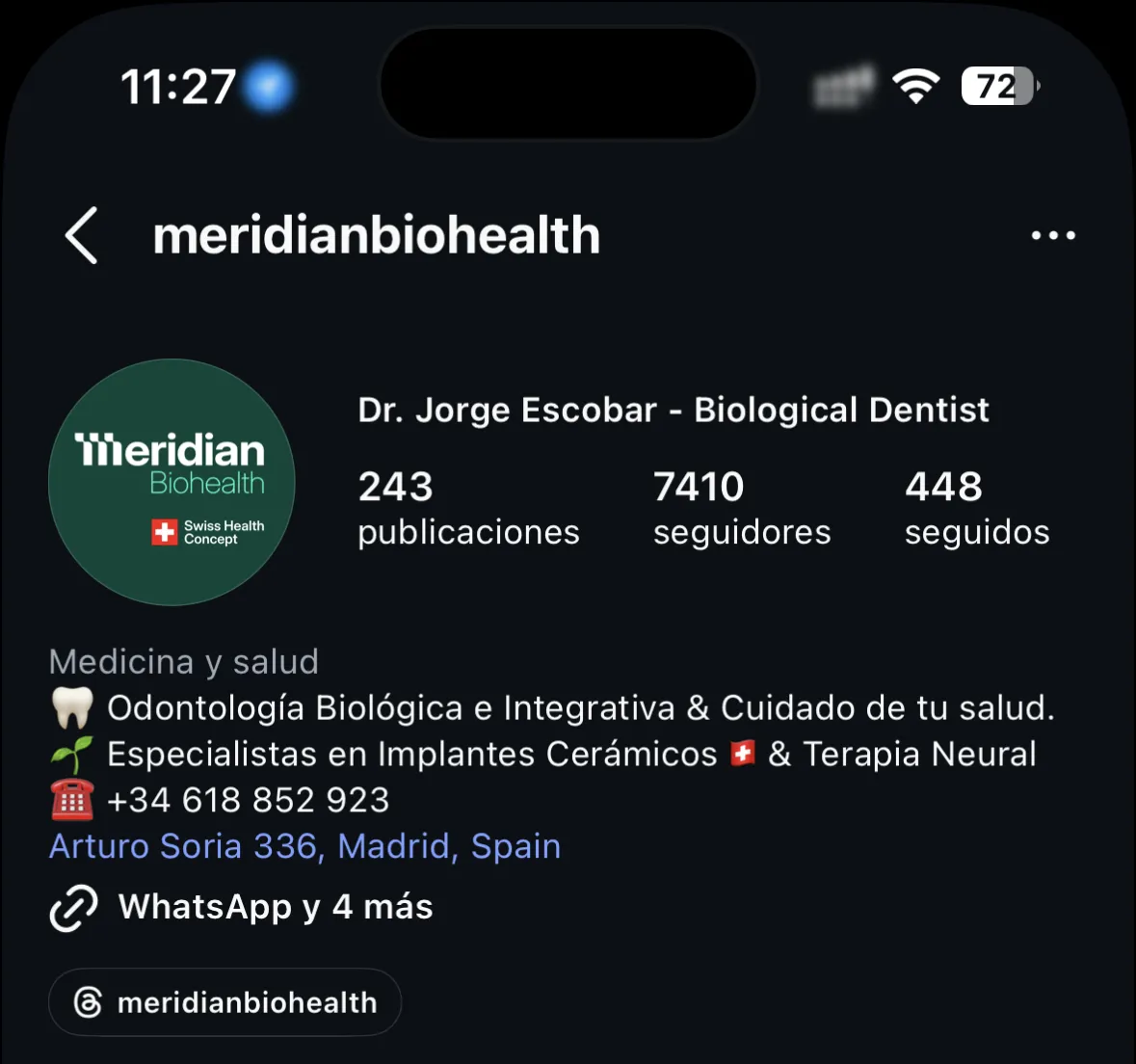
Meridian Biohealth
@meridianbiohealth · Dr. Jorge Escobar
Biological dentistry · Madrid
They don't have an in-house marketing department. They don't struggle with scripts every week. They don't block out their patient schedule to film. I go to their clinic in Madrid once a month, set up the gear, get the teleprompter running, we read through the month's scripts and that's where the pieces come from. I edit, schedule, and everything goes out over the following four weeks.
In this post I explain, without embellishment, how the system is set up, what problem it solves and why working this way pays off for a clinic compared with improvising social media content.
The challenge: publishing consistently without shutting down the clinic
Meridian Biohealth is a biological and integrative dentistry clinic in Madrid. Dr. Jorge Escobar wanted a serious presence on social media to explain concepts that are hard to get across in a 30-minute appointment: ceramic implants, neural therapy, the oral microbiome, ozone, and the link between oral and systemic health.
The problem wasn't a lack of vision. He knew exactly what he wanted to say. The problem was operational. A clinic with a packed schedule can't stop every week to film. And a medical professional shouldn't be editing Reels at eleven at night.
What he needed was a system. A single monthly session that produced enough footage for the whole month, plus an editing and publishing process he didn't have to touch.
The system: one session a month, 30 pieces on social media
The method is deliberately simple. The fewer decisions the client has to make on shoot day, the better the content turns out.
1. Scripts locked before we set foot in the clinic
Before the session, we finalize the month's scripts. We don't improvise on camera. Every Reel has its exact script, written to sound natural when read aloud and to fit the vertical format of Instagram and TikTok without awkward cuts.
2. One visit to the clinic each month
I go to Arturo Soria with the gear. Camera, sound, lighting, teleprompter. We make use of several real spaces in the clinic: the consulting room, the implant suite, reception. That gives us different visual backgrounds without changing location.
3. Teleprompter: zero memorising
This is the part that makes the biggest difference to the result. Dr. Escobar reads from the teleprompter while looking straight into the lens. He doesn't have to learn anything. There aren't fifteen takes to get a line clean. And his eyeline stays locked on the lens, which is exactly what vertical video needs to stop viewers from scrolling past.
4. Two hours of filming, a four-hour block
We block out four hours in the diary, but the actual time in front of the camera is two. The rest is setting up the gear, changing shots and breaks. We move between different areas of the clinic so the 30 pieces don't all look the same, even though they were filmed on the same day.
5. Managed editing and publishing
After the shoot, I take all the footage with me. The edit includes typography, burned-in subtitles, snappy cuts, B-roll of the clinic and graphic elements designed to hold attention in the first three seconds. The pieces are scheduled so the feed keeps publishing steadily throughout the month.
Results: 30 pieces a month from two hours of the client's time
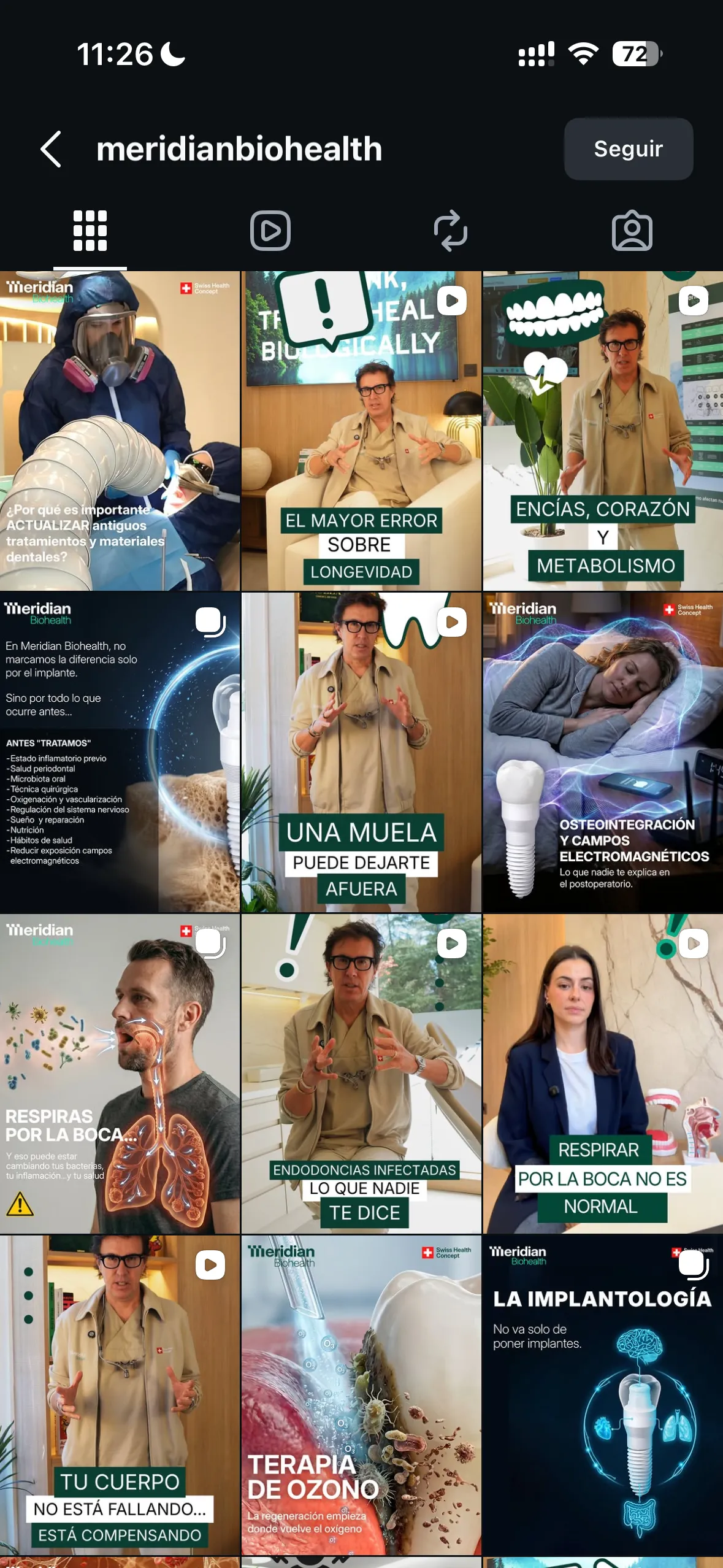
- 30 Reels published every month on Instagram and repurposed on other platforms.
- Two hours of actual filming a month from the clinic team.
- One visit to the clinic each month. The client never has to travel to a studio.
- A single point of contact for scripting, filming, editing and publishing.
- A consistent feed: the same look, the same typography and the same approach across every piece.
Why this model works
It works because it removes the three things that kill content at companies that aren't agencies: the friction of sitting down to film, the uncertainty about what to say, and the scattered process that comes from having several people involved.
A monthly session with prepared scripts and a teleprompter makes filming predictable. It's in the diary, it takes as long as it needs to, and it produces footage for weeks. After that, there's nothing the client has to do until the next session.
It also works because it isn't generic content. It's filmed in his clinic, with his equipment and his professional judgement. And that shows. A piece filmed in his implant suite with his real equipment conveys authority in a way a generic set simply can't.
What kind of business this makes sense for
It makes sense when there's an expert who wants to communicate but doesn't have the time, when the brand depends on explaining complex services clearly, and when there's already a minimum volume of patients, clients or leads to justify investing in a consistent presence. Clinics, law firms, consultancies, trainers, professional services firms: the model adapts without much change.
It makes less sense if what you're after is high-volume, low-cost content with no real thought behind it. This isn't that. This is producing a modest volume, done well and consistently, with professional judgement behind every piece.
Frequently asked questions
Do you need experience in front of the camera?
No. The teleprompter solves 90% of the problem. You read what's written while looking into the lens, and the piece comes across as natural without memorising or improvising.
Who writes the scripts?
We prepare them together before the session, based on the topics the client wants to cover. The technical idea comes from him; I take care of adapting it to the vertical format and the pace a Reel needs.
Why film at the clinic rather than in a studio?
Because the clinic is the strongest visual asset. Filming in his implant suite with the real medical equipment conveys authority. A neutral studio works for anyone; his clinic only works for him.
Do you work with businesses that aren't clinics?
Yes. I apply it with law firms, consultancies, trainers and service businesses. The system barely changes: a monthly visit to the client, a teleprompter session, locked scripts, and managed editing and publishing.
Where can I see the results?
On the clinic's Instagram: instagram.com/meridianbiohealth. Most of the posts with a play icon in the feed were filmed in monthly sessions like the one described in this case study.